AstroWeather.com

AstroWeather.comAstroWeather.comAstroWeather.com

AstroWeather.com

AstroWeather.comAstroWeather.comAstroWeather.com
  • Home
  • ZODOC
  • TC EXPERIMENT
  • Severe Weather Forecasts
  • More
    • Home
    • ZODOC
    • TC EXPERIMENT
    • Severe Weather Forecasts
  • Home
  • ZODOC
  • TC EXPERIMENT
  • Severe Weather Forecasts

ZODOC TROPICAL CYCLONE EXPERIMENT

Prospective Long-Range Timing Forecasts — 2026


The 2026 ZODOC Tropical Cyclone Experiment is a prospective test of whether astronomical timing signals can identify periods of increased tropical cyclone activity weeks in advance.


Forecasts are prepared from astronomical timing data and issued before the forecast periods begin. Once issued, the forecast windows are not revised to fit subsequent weather.


The primary forecast target is timing. ZODOC identifies specific Times of Interest (TOI) during which tropical cyclone development or intensification is expected to become more likely.


Cyclogenesis is defined as the first occurrence of Tropical Depression strength (approximately 25–30 kt). Earlier Invest or disturbance stages do not count as a genesis hit. Rapid Intensification (RI)is evaluated separately when it is specifically forecast.


Each forecast is subsequently compared with observed tropical cyclone activity and classified using predetermined verification rules. Forecast issue dates, lead times, hits and misses are retained so that the experiment can be evaluated objectively.


The purpose is not to replace conventional meteorological forecasting, but to test whether astronomical timing contains useful long-range information about when tropical cyclone activity is more likely to occur.

2026 RESULTS AT A GLANCE

14 of 17 — HIT

14 of 17 — HIT

14 of 17 — HIT

  82.4% of forecast TOI windows verified 

~30 DAYS

14 of 17 — HIT

14 of 17 — HIT

 Average forecast lead time 

45 CYCLONES

14 of 17 — HIT

33 of 45 — IN TOI

 Observed May 1–September 21, 2026 

33 of 45 — IN TOI

68.5% OF ACTIVITY (CEI)

33 of 45 — IN TOI

  73.3% of cyclogenesis events occurred within TOI windows 

61.8% COVERAGE

68.5% OF ACTIVITY (CEI)

68.5% OF ACTIVITY (CEI)

 89 of 144 calendar days were within TOI windows 

68.5% OF ACTIVITY (CEI)

68.5% OF ACTIVITY (CEI)

68.5% OF ACTIVITY (CEI)

  10,690 of 15,605 total cyclone activity occurred within TOI windows 

2026 FORECAST vs. OBSERVED CYCLOGENESIS

Forecast vs. Observed Cyclogenesis

 The timeline above compares the prospectively issued ZODOC Time-of-Interest windows with observed tropical cyclone genesis through September 21, 2026. Basin colors identify each genesis event; filled markers occurred within a forecast TOI window and open markers occurred outside the windows. 

2026 PROSPECTIVE FORECAST ARCHIVE

    2026 STATISTICAL VERIFICATION

    1. Genesis Concentration


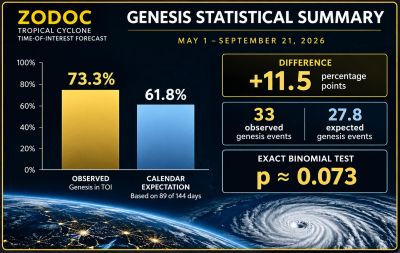
    From May 1 through September 21, 2026, ZODOC Time-of-Interest (TOI) windows covered 89 of 144 calendar days (61.8%). During the same period, 33 of 45 observed cyclogenesis events (73.3%) occurred within those forecast windows.

    If cyclogenesis were distributed randomly across the observation period, calendar coverage provides a simple null expectation. At 61.8% coverage, approximately 27.8 of the 45 genesis events would be expected to occur within TOI windows. The observed total was 33, approximately 5.2 events above that expectation.

    The observed genesis concentration was therefore 11.5 percentage points above calendar coverage. A one-sided exact binomial test gives p ≈ 0.073 for observing 33 or more of 45 genesis events within the TOI windows.

    This result is suggestive but does not reach the conventional p < 0.05 threshold. The binomial result should also be interpreted as a preliminary statistical measure because tropical cyclone genesis events are not necessarily completely independent in time.
    2. Forecast Window Verification


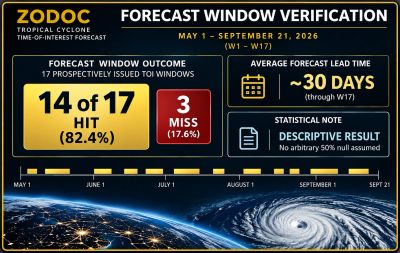
    Through September 21, 2026, 14 of 17 prospectively issued Time-of-Interest (TOI) windows verified, producing an observed window hit rate of 82.4%.

    The forecasts were issued before the forecast periods began and were not subsequently revised to fit observed tropical cyclone activity. Average forecast lead time through W17 was approximately 30 days.

    The 14 HIT / 3 MISS result is reported descriptively rather than assigning an arbitrary 50% chance baseline. TOI windows differ in duration, and tropical cyclone activity varies substantially through the season; therefore, a simple 50/50 binomial model would not provide a well-defined null expectation for window verification.

    Window verification is consequently presented as a measure of forecast performance, while the genesis concentration analysis above provides the experiment's primary preliminary statistical test.
    3. Cyclone Activity (CEI)


    Cyclone Energy Index (CEI) provides a broader measure of tropical cyclone activity by incorporating daily cyclone intensity rather than counting genesis events alone.

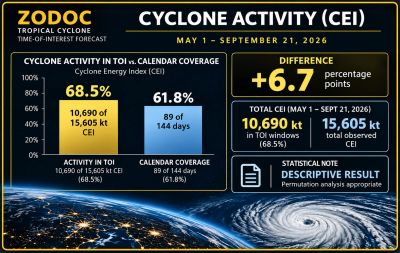
    From May 1 through September 21, 2026, total observed cyclone activity was 15,605 kt CEI. Of this total, 10,690 kt (68.5%) occurred within ZODOC TOI windows.

    TOI windows occupied 61.8% of the observation period, while containing 68.5% of measured cyclone activity. Cyclone activity was therefore concentrated within TOI periods by 6.7 percentage points above calendar coverage.

    A simple binomial significance test is not appropriate for CEI because cyclone intensity persists across consecutive days and observations from the same storm are statistically dependent. A permutation or block-randomization analysis that preserves the temporal structure of cyclone activity is more appropriate for evaluating statistical significance.

     CEI is therefore reported here as a descriptive secondary result. A formal significance estimate will require an appropriate time-preserving randomization analysis. 
     Interim Analysis — 2026 Season in Progress
    Results shown above cover May 1 through September 21, 2026 (W1–W17). Forecasts and verification statistics will continue to be recorded prospectively through completion of the 2026 experiment. Final season statistics will be calculated after the observation period closes. 

    ZODOC MASTER KIT v2.0

    Prospective Statistical Verification Protocol — 2026


    Protocol established: September 29, 2026
    Status: LOCKED before verification of W19 and subsequent 2026 forecasts


    Purpose

    This protocol establishes in advance how the 2026 ZODOC Tropical Cyclone Time-of-Interest Forecast will be statistically evaluated at the completion of the Northern Hemisphere season.

    The purpose is to determine whether prospectively issued ZODOC Time-of-Interest (TOI) windows identify tropical cyclone genesis and activity at rates greater than would reasonably be expected from comparable randomly placed forecast windows.

    ZODOC forecasts are fixed when issued and are not revised after subsequent tropical cyclone activity becomes known.

    1. Primary Event — Formal Genesis

    The primary event is Formal Genesis (FG), defined as the first official Tropical Depression classification, approximately 25–30 kt.

    Each tropical cyclone contributes only one genesis event.

    Pre-Genesis Organization (PGO), Tropical Storm designation, peak intensity and dissipation do not substitute for Formal Genesis.

    2. Forecast Windows

    The analysis will use the actual prospectively issued 2026 TOI windows.

    Each window retains its original:

    • start and end dates;
    • forecast probability;
    • issue date;
    • and resulting lead time.

    Overlapping TOI dates are counted only once when calculating total calendar coverage.

    Future 2026 TOI windows will be determined solely from the ZODOC forecasting method and will become fixed when issued.

    3. Historical Reference Period

    The primary historical reference period will be:

    1971–2020

    The years 2021–2025 will remain outside the primary historical reference distribution and may be examined separately as a recent-period sensitivity test.

    2026 will not be included in the historical null distribution used to evaluate the 2026 forecast.

    4. Monte Carlo Procedure

    Historical tropical cyclone genesis dates remain fixed on the dates on which they actually occurred.

    Equivalent sets of artificial TOI windows will then be generated randomly within historical Northern Hemisphere seasons.

    The simulations will preserve the important characteristics of the actual 2026 forecast structure, including:

    • number of TOI windows;
    • individual window lengths;
    • seasonal boundaries;
    • and total forecast exposure.

    A minimum of 100,000 Monte Carlo simulations will be performed. Additional simulations may be used if greater p-value resolution is required.

    5. Primary Statistic — Genesis Incidence Rate Ratio

    The pre-specified primary statistic is the Genesis Incidence Rate Ratio (IRR):

    Genesis events per day inside TOIs ÷ Genesis events per day outside TOIs

    An IRR of:

    • 1.00 indicates equal genesis rates inside and outside TOIs;
    • greater than 1.00 indicates increased genesis within TOIs;
    • less than 1.00 indicates decreased genesis within TOIs.

    The final ZODOC IRR will be compared with the Monte Carlo distribution.

    The Monte Carlo p-value will be the proportion of simulated forecasts producing an IRR equal to or greater than the observed 2026 ZODOC IRR.

    6. Two Null Models

    Two complementary Monte Carlo null models will be used.

    Null A — Random-Window Test: Equivalent forecast windows are randomly positioned within historical seasons while preserving the ZODOC window structure.

    Null B — Seasonality-Matched Test: Randomized windows are constrained to comparable portions of the tropical cyclone season, reducing the possibility that apparent skill results merely from forecasting during climatologically active periods.

    Results from both tests will be reported.

    7. Secondary Measures

    The following are pre-specified secondary measures:

    Forecast performance

    • TOI hits and misses
    • TOI hit percentage
    • Mean forecast probability
    • Mean forecast lead time

    Cyclone concentration

    • Number and percentage of genesis events inside TOIs
    • Number and percentage outside TOIs
    • Calendar percentage covered by TOIs
    • Genesis rates inside and outside TOIs

    Probability scoring

    • Mean logarithmic score
    • Brier Score
    • Brier Skill Score against the designated reference forecast

    Activity measures

    • Rapid Intensification (RI) occurrence
    • Cyclone Energy Index (CEI) inside and outside TOIs
    • CEI per TOI and non-TOI day

    These measures are secondary and will not replace the pre-specified Genesis IRR as the primary Monte Carlo test.

    8. Interpretation

    Statistical significance and effect size will be reported separately.

    A small p-value indicates that the observed result is unusual under the specified null model. The IRR and related effect sizes indicate the magnitude of the observed difference.

    Results will therefore not be judged solely by whether a particular p-value crosses the conventional 0.05 threshold.

    Confidence intervals will be reported where appropriate.

    9. Prospective Lock

    This statistical protocol was established September 29, 2026, before verification of W19 and subsequent 2026 forecasts.

    The following will not be changed in response to later 2026 forecast results:

    Primary event: Formal Genesis
    Primary statistic: Genesis Incidence Rate Ratio
    Primary historical reference: 1971–2020
    Primary method: Monte Carlo comparison
    Null models: Random-window and seasonality-matched tests

    Any additional statistical analyses developed after the final 2026 results become known will be clearly identified as exploratory rather than pre-specified

    Copyright © 2026 AstroWeather.com - All Rights Reserved.


    Powered by

    This website uses cookies.

    We use cookies to analyze website traffic and optimize your website experience. By accepting our use of cookies, your data will be aggregated with all other user data.

    DeclineAccept